- The Problem It Solves: Qubits are incredibly fragile and prone to environmental noise. To fix an error, a system must read out data from a Quantum Processing Unit (QPU), calculate where the error happened using a classical computer, and send a correction signal back—all in a matter of microseconds before the qubit collapses. [1]
- The Partner Focus: Companies like Quantinuum, IonQ, and Quantum Machines use NVQLink’s ultra-low latency (<4 microseconds) data transfer to offload massive error-decoding math directly onto NVIDIA GPUs. It turns a fragile quantum experiment into a stable, hybrid "Quantum-GPU" supercomputer. [1, 2, 3, 4]
- Quantum Sensors (The Present): These manipulate individual atoms to measure microscopic changes in gravity, magnetic fields, or temperature. They are already commercially viable. They don't require error correction because they aren't calculating anything; they are just observing. Examples include atomic clocks, submarine navigation systems that don't need GPS, and medical brain scanners. [1]
- Quantum Computing (The Future): This requires entangling thousands or millions of qubits together to run mathematical algorithms. Because keeping that many qubits stable is a massive engineering challenge, useful quantum computing is much further away than quantum sensing. [1]
THE 10-YEAR TIMELINE (The Pure Monster)
[ Millions of Perfect Qubits ] ──► Shor's Algorithm ──► Instantly Shatter RSA Encryption

THE 2-YEAR TIMELINE (The Hybrid Sniper)
[ Imperfect QPU + NVIDIA GPU ] ──► Quantum Analysis ──► Exploit Blockchain Vulnerabilities Early
- The 10-Year Reality: To effortlessly break standard global encryption (like RSA) natively, an independent quantum computer needs millions of error-corrected qubits. We are a decade away from that hardware scale. [1]
- The 2-Year Threat: Bad actors don't need a perfect quantum computer to cause chaos. Within the next 2 years, hackers can use imperfect, noisy quantum processors hooked up to high-speed AI supercomputers (via frameworks like NVQLink) to run quantum-classical hybrid analysis. This hybrid method can spot mathematical shortcuts or optimize code-cracking loops to exploit specific vulnerabilities in early blockchain protocols long before a standalone "pure" quantum computer exists. [1, 2, 3]
- NVIDIA's Involvement: While the Genesis Prize Foundation highlights regional tech breakthroughs, NVIDIA is deeply embedded in the underlying ecosystem. NVIDIA is building a massive $1.5 billion AI and Quantum-capable data center infrastructure in Israel. [1, 2]
- The Connectors: Top-tier Israeli quantum software and hardware builders—most notably Classiq and Quantum Art (both in late-stage transitions to list on Wall Street)—rely directly on NVIDIA’s CUDA-Q platform to design their quantum network layouts. [1, 2]
- SpaceX & Starlink (Satellite Optimization): Managing a constellation of tens of thousands of Starlink satellites moving in low-Earth orbit requires routing millions of laser-mesh data beams simultaneously. This is a massive combinatorial optimization problem that classical computers struggle to calculate in real time. SpaceX will likely leverage quantum-inspired optimization models to manage this orbital network topology.
- Materials Science for Starship: Simulating how novel metal alloys behave under the extreme thermal loads of atmospheric re-entry requires quantum chemistry simulation—a domain where NVIDIA's BioNeMo and quantum partners are leading. [1]
- Quantum Key Distribution (QKD) Securing 6G: 6G will integrate terrestrial cellular towers with satellites and autonomous drones. This massive attack surface requires un-hackable security. 6G standards are incorporating QKD, which uses the laws of quantum mechanics (entangled photons) to ensure that if a hacker tries to eavesdrop on a 6G data beam, the quantum state alters instantly, alerting the network.
- Quantum RF Sensors for 6G: 6G will operate at ultra-high, sub-terahertz frequencies. These signals carry immense amounts of data but decay rapidly and are easily blocked by walls or rain. 6G base stations are experimenting with Rydberg atomic quantum sensors to detect incredibly faint, high-frequency radio waves that traditional copper antennas completely miss, drastically expanding network reliability.
- 1. Japan, Korea, Taiwan, Hong Kong, Singapore
- QuEL (Japan): Early pioneer specializing in microwave control electronics and cryogenic-compatible hardware for scalable superconducting quantum systems; integrated into NVIDIA’s NVQLink ecosystem.
- Quapp (Japan): Cloud-native quantum software platform building middleware to bridge enterprise AI/HPC clusters with quantum simulation frameworks; joined NVIDIA Inception.
- SDT (South Korea): Precision quantum tech and modular measurement infrastructure builder; first Korean entity integrated into NVIDIA’s NVQLink hybrid quantum-GPU architecture. [1, 2]
- 2. Rest of APAC
- Q-CTRL (Australia): Global leader in quantum control infrastructure, providing firmware and software to suppress hardware error and stabilize qubits across various QPU architectures.
- Quantum Brilliance (Australia/Germany): Room-temperature diamond quantum accelerators leveraging miniaturized nitrogen-vacancy centers in diamond; active in CUDA-Q scaling. [1, 2, 3, 4, 5]
- 3. India
- Atomesus (India): Deep-tech and simulation-focused computation startup accepted into NVIDIA Inception, working on advanced mathematical modeling and molecular geometry layers.
- Note: India’s quantum-AI footprint leans heavily into national supercomputing fabrics (e.g., C-DAC integrations) rather than pure standalone quantum hardware startups. [1]
- 4. Middle East or GASH (Germany, Austria, Switzerland, Hungary)
- Classiq (Israel): Breakthrough quantum-software developer building a comprehensive platform for automated quantum circuit generation; deeply reliant on CUDA-Q.
- planqc (Germany): Max Planck Institute spinout developing high-acuity neutral-atom quantum computers anchored to European supercomputing centers.
- Alpine Quantum Technologies - AQT (Austria): University of Innsbruck spinout commercializing trapped-ion quantum computers tailored for high-reliability hybrid data center environments. [1, 2, 3, 4, 5]
- 5. UK and Far North Europe
- Riverlane (UK): Developer of Deltaflow, a universal quantum error-correction operating system that forms a critical software bridge for low-latency GPU-QPU links.
- IQM Quantum Computers (Finland): Full-stack European hardware builder designing superconducting quantum processors and on-premises quantum systems for institutional supercomputing hubs.
- Algorithmiq (Finland): Quantum algorithms and error-mitigation startup merging advanced information theory with classical deep-learning loops for life-science simulations. [1, 2, 3, 4, 5]
- Canada is a major global powerhouse in quantum computing, anchored by world-class research institutes at the University of Waterloo (Institute for Quantum Computing) and the University of Toronto. Canada’s ecosystem features several prominent, globally recognized quantum companies and advanced scale-ups: [1, 2, 3]
- Xanadu Quantum Technologies (Toronto, ON): A world leader in photonic quantum computing (using light particles for computation) that went public via a SPAC merger on Nasdaq and the TSX. Xanadu also develops PennyLane, the premier open-source software library for quantum machine learning and differentiable programming used globally across hardware platforms. [1, 2, 3, 4, 5]
- D-Wave Quantum Inc. (Burnaby, BC): The pioneer and commercial leader in quantum annealing systems, which recently expanded its footprint into gate-based hybrid architectures through strategic multi-million dollar asset acquisitions. [1, 2, 3, 4, 5]
- Photonic Inc. (Coquitlam, BC): Developing a highly scalable quantum computing architecture based on silicon spin qubits and "T-centres," creating networked, fault-tolerant quantum processors that interface natively with standard telecom fiber-optic wavelengths. [1, 2, 3]
- Anyon Systems (Montreal, QC): A specialist in building turnkey, superconducting quantum computers and high-performance cryogenic hardware systems for institutional and government compute centers. [1, 2]
- Nord Quantique (Sherbrooke, QC): An innovative deep-tech firm focusing on bosonic error correction codes to dramatically reduce the physical overhead of building reliable, fault-tolerant logical qubits. [1, 2, 3]
Would you like to explore how Xanadu's PennyLane software framework bridges quantum circuits directly into classical PyTorch and NVIDIA GPU training pipelines?
- 6. Rest of EU
- PASQAL (France): Neutral-atom quantum computing pioneer building programmable processor arrays used extensively across industrial simulation workflows.
- Quandela (France): Photonic quantum technology company manufacturing single-photon modular systems and operating dedicated commercial cleanroom foundries.
- eleQtron (Germany): Trapped-ion quantum architecture developer using magnetic-field control mechanisms to scale modular processor systems. [1, 2, 3, 4, 5]
- 7. Global South
- Terra Quantum (Switzerland/Global Operations/LatAm touchpoints): Hybrid quantum-classical optimization and cryptography provider deploying high-speed computational solutions for enterprise partners in developing infrastructure corridors. [1]
- 8. USA
- IonQ (USA): Trapped-ion quantum computing hardware developer offering cloud-accessible utility-scale quantum systems integrated into modern supercomputer networks.
- Quantinuum (USA/UK): Industry titan in trapped-ion quantum computing and error-correction software, actively implementing ultra-low latency NVQLink integrations.
- QuEra Computing (USA): Neutral-atom quantum computer developer spun out from Harvard and MIT, focusing on scalable array
- configurations and large logical qubit counts.
- Infleqtion (USA): Quantum sensing and neutral-atom computing pioneer building ruggedized quantum components for terrestrial and aerospace operations. [1, 2, 3, 4, 5]
[ High-Level Code: Python / C++ / Classiq / Qrisp ]
                        │
                        ▼
         ┌─────────────────────────────┐
         │      CUDA-Q MLIR Core       │  ◄── Language-Specific Dialects
         └──────────────┬──────────────┘
                        │
                        ▼
         ┌─────────────────────────────┐
         │  Split Compilation Engine   │
         └──────┬───────────────┬──────┘
                │               │
                ▼               ▼
      [Host / GPU Code]   [Quantum Kernels]
      (NVVM / LLVM IR)    (QIR / Target APIs)
                │               │
                ▼               ▼
   [NVIDIA Hopper/Blackwell]  [Regional QPU Runtime]
   (cuQuantum / NVQLink)      (Pasqal QRMI / IQM / AQT)
nvq++ compiler and converted into custom MLIR dialects. MLIR allows CUDA-Q to understand quantum operations, classical variables, and tensor instructions inside a single unified data structure without forcing an early commitment to a specific hardware vendor. [1, 2, 3]- Classical Host/GPU Code: Instructions destined for classical compute are lowered into standard LLVM IR or NVVM IR to execute parallel math or state-vector simulations via cuQuantum on NVIDIA GPUs. [1, 2, 3]
- Quantum Kernels: Quantum-specific instructions are translated into Quantum Intermediate Representation (QIR). QIR acts as the universal adapter plug. [1, 2]


IBM is committing up to $50 million worth of quantum compute access for the US Genesis Mission, and more
An IBM project was also selected to accelerate AI-driven quantum application discovery.
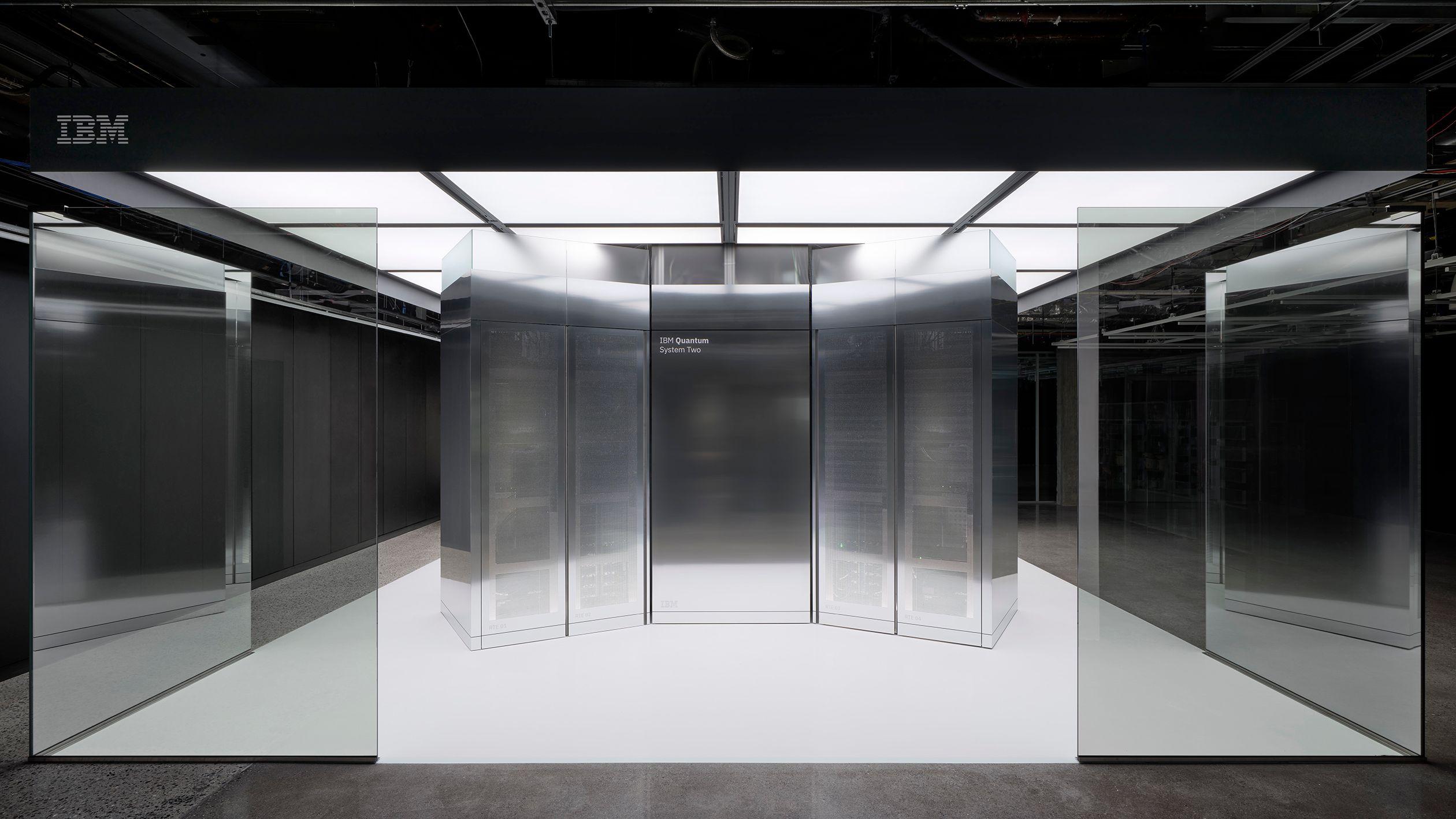
IBM envisions a future of compute that combines quantum, AI, and classical into a framework capable of solving challenges beyond any of those compute hardware paradigms alone. That’s why we’re excited to announce today that the U.S. Department of Energy (DoE) Genesis Mission selected an IBM project to accelerate AI-driven scientific discovery in a highly selective process, and that IBM will contribute up to $50 million of quantum system access to further the objectives of the DoE’s plan to help realize that future.
The department today announced the first projects selected under the Genesis Mission Request for Applications (RFA) as part of President Trump’s Genesis Mission. IBM is participating extensively in this mission as a member of the Genesis Mission Consortium, a select group of industry leaders committed to making the operation successful.
“Achieving the ambitious vision of the Genesis Mission will require invention and innovation across every layer of computation — from hardware and architecture to algorithms,” said Jay Gambetta, Director of IBM Research and IBM Fellow. “As IBM continues to build the future of computing, we are prepared and honored to help the United States bring to life a new platform that weaves together quantum computers, AI, and high-performance computing to dramatically expand our country’s capacity for scientific discovery.”
The Genesis Mission is a historic national initiative led by the DoE, which is building the world’s most powerful integrated science discovery platform. By uniting government, industry, academia, and philanthropy, the mission is accelerating breakthroughs in energy, scientific discovery, and national security through a new platform that combines AI, supercomputing, quantum computing, and advanced scientific instruments. The Genesis Mission directly aligns with IBM’s vision for computing. Over the past decade, IBM has advanced the technologies required for fault-tolerant quantum computing, in addition to showing real value from AI can emerge through small and efficient scientific models. An now, IBM is spearheading the vision for an era of quantum-centric supercomputing — where high-performance computing, quantum computing, and AI operate together in concert to solve problems no single technology could address on its own.
IBM is already spearheading collaborative projects across research, government, and industry aligned with the goals of the Genesis Mission. Most recently, researchers at Oak Ridge National Laboratory (ORNL), IBM, and Cleveland Clinic used a quantum-centric workflow to simulate molten salts, materials used to generate tritium fuel for fusion reactors. That workflow further demonstrates a loop of quantum computers, supercomputers, and AI. In this case, AI agents proposed and screened many candidate salts from an ORNL database of 70 years of molten salt research, while GPU-accelerated supercomputers modeled them, and quantum computers tackled the finest details and most challenging aspects the simulation. This workflow has the potential to help the US realize fusion energy faster.
Today, IBM was also selected to lead a project selected under the Genesis Mission RFA. The goal of the Phase I RFA awards is to identify promising pathways toward transformative scientific capabilities and establish a foundation for future investment and scale. Project teams will design and demonstrate research workflows that integrate AI with scientific investigation, while rigorously evaluating whether those approaches can accelerate discovery, improve predictive capabilities, enhance experimentation, or generate new scientific insights.
The IBM project examines how AI and advanced accelerator hardware could support the development of more effective quantum applications by inverting the conventional workflow. This project begins with proven quantum algorithms and searches the scientific literature to find real-world problems that could fit these algorithms, aided by an agentic research assistant. This assistant will be able to read research, propose candidate matches, check them against formal criteria, and explain the reasoning for human experts to review. Humans are charged with defining the criteria and validating the proposals, while the AI performs the vast search beyond the capabilities beyond any one researcher.
To support the Genesis Mission, IBM will also provide up to the equivalent of $50 million of its world-leading utility-scale quantum compute access, powered by its 156-qubit IBM Quantum Heron and 120-Qubit IBM Quantum Nighthawk processors to DoE national labs and their collaborators over the next five years. Currently IBM has 15 quantum computers operational, with average uptime greater than 97% and round-the-clock access serving our more than 250,000 users. The latest Nighthawk-based systems will support 120 programmable qubits capable of 5,000+ QuOps and a throughput of up to 100,000 circuits per second. This contribution also features technical support for integration of quantum computing with classical HPC and Al resources at the national laboratories, as well as collaboration on agreed-upon activities.
IBM is already deeply integrated into the nation's quantum science ecosystem through IBM Quantum Innovation Center’s existing relationships with DoE national laboratories, including Lawrence Berkeley National Laboratory, Oak Ridge National Laboratory, and Los Alamos National Laboratory — as well as potential initiatives with four of the five DoE National Quantum Information Science Research Centers. Altogether, this provides a strong foundation for advancing the Genesis Mission.
IBM is proud to help lead this mission, and we believe its outcomes will be transformative to US society overall. We believe that together with the DoE and its collaborators, we can unlock the scale of computing required to tackle the United States’ most pressing scientific challenges.
- The Orchestrator: Dr. Darío Gil, who stepped down from executive leadership at IBM Research to serve as the confirmed Under Secretary for Science and Innovation at the Department of Energy. He oversees the entire programmatic execution of the mission. [1, 2]
- The 17 National Labs: The mission unifies the nation's 17 flagship DOE National Laboratories (such as Argonne, Oak Ridge, Brookhaven, and Lawrence Berkeley) into a singular computational mesh. [1, 2, 3]
- The 26 Lighthouse Challenges: The foundational strategy centers on 26 core Science and Technology "Lighthouse Challenges". These include accelerating fusion energy, reducing nuclear deployment timelines, discovering novel semiconductor materials, and optimizing the Texas power grid. (Note: Due to massive multi-agency expansion in mid-2026, the White House expanded this list to 33 challenges to incorporate space and biology). [1, 3, 4, 5, 6]
- AI Agents as Lead Researchers: Autonomous AI agent frameworks ingest millions of federal scientific datasets to generate new physical and chemical hypotheses. [, 2]
- Autonomous Supercomputer Allocation: The agent automatically writes its own code and executes simulations across thousands of cluster nodes (like the 10,000-GPU clusters running at Argonne). [1]
- Physical Robotic Handoff ("The Robot Lab"): Once the simulation confirms a viable molecule or material structure, the system seamlessly hands the execution instructions over to automated, robotic experimental laboratories. The physical robots mix the compounds or test the material stress under physical conditions without human intervention. [1]
- The Computational Hardware: The very first major computing clusters deployed for the Genesis Mission—such as the massive 10,000-GPU system deployed at Argonne National Laboratory—were built directly as a partnership between NVIDIA and Oracle to achieve the "unprecedented calculation speeds" Gil required. [1]
- The AI Software Framework: To power the "agentic" part of the platform, the national labs are running heavy variants of NVIDIA NeMo frameworks and NIM microservices. These toolsets ensure that multi-modal foundation models can reason over chemical formulas and physics vectors, rather than just text tokens.
- The Blueprint: The Department of Energy has set an aggressive operational target: utilize Genesis infrastructure to build and deploy the world’s first scientifically relevant, fault-tolerant quantum computer by 2028. [1, 2]
- The AI Intervention: Instead of relying solely on physical engineering to stabilize qubits, national labs are using Genesis AI models to automate Quantum Error Correction (QEC). High-performance AI algorithms act as active control loops, dynamically identifying and mitigating environmental noise in qubits before they decohere. [1, 2, 3, 4]
- The Infrastructure Multiplier: Reflecting Darío Gil's deep ties to quantum architecture, IBM committed up to $50 million in quantum system access directly to the Genesis Mission. [1]
- The Impact: This creates a direct bridge between IBM's utility-scale quantum processors and the national labs' AI supercomputing arrays. Scientists no longer treat quantum as an isolated sandbox; they are actively building software pipelines where an AI backbone hands off hyper-complex combinatorial math to quantum nodes seamlessly. [1, 2, 3]
- The Workflow Matrix: In the Genesis model, a macro-problem (like mapping a stable nuclear fusion reaction grid) is ingested by an enterprise AI agent. The AI models the data flow, using classical GPU clusters to calculate 95% of the physics, but dynamically routes the core molecular entanglement problems straight to a quantum processor—creating a true hybrid "Quantum-AI" workflow. [1, 2, 3]
- The Fusion Breakthrough: Utilizing Genesis-aligned framework methodologies, IBM partnered with Oak Ridge National Laboratory to solve a massive fusion energy roadblock regarding tritium recovery. [1, 2, 3]
- The Mechanics: Simulating how molten salt ("FLiBe") behaves as a blanket to trap tritium isotope neutrons is computationally impossible for traditional classical supercomputers alone. By deploying quantum algorithms optimized by machine learning workflows, they can map the exact molecular efficiency matrix required to sustain long-term commercial fusion reactions. [1, 2]
- The Disconnect: The global mathematical greats are writing highly advanced, theoretical quantum algorithms. However, because they lack localized, nation-scale GPU clusters, they cannot easily test or ground-truth their math. [1, 2]
- The AI Substitute: Conversely, US tech giants and national labs are throwing massive, brute-force AI supercomputing arrays at quantum problems. They use AI neural networks to guess-and-test quantum error corrections. Rather than executing an elegant mathematical proof written by a global theorist, the US model relies on data engineering pipelines running on standard GPU infrastructures. [1, 2, 3, 4]
               ┌────────────────────────────────────────┐
               │         GLOBAL QUANTUM RACE            │
               └───────────────────┬────────────────────┘
                                   │
         ┌─────────────────────────┴─────────────────────────┐
         ▼                                                   ▼
┌─────────────────────────────────┐                 ┌─────────────────────────────────┐
│       UNITED STATES MODEL       │                 │          CHINA MODEL            │
├─────────────────────────────────┤                 ├─────────────────────────────────┤
│ • Focus: Software & Processing  │                 │ • Focus: Hardware & Cryptography│
│ • Hubs: Cloud Networks / AI Labs│                 │ • Hubs: Terrestrial Fibers / Sat│
│ • Goal: Computing Supremacy     │                 │ • Goal: Un-Hackable Comm Mesh   │
└─────────────────────────────────┘                 └─────────────────────────────────┘
- The Pipeline Focus: Under programs like the DOE's Quantum Genesis initiative directed by Dr. Darío Gil, the US prioritizes linking software development platforms with massive AI infrastructure to achieve fault-tolerant quantum computing. [1, 2, 3]
- The Strategic Goal: The US wants to use massive hybrid GPU-Quantum clusters to run deep simulations for drug discovery, advanced materials, and supply chain logistics. America dominates the software developer workflow layer completely, ensuring global quantum coders operate natively on US-designed developer ecosystems. [1, 2, 3]
- The Pipeline Focus: China leads the world in physical quantum communications and cryptographic networking. They have built and operationalized massive, country-scale ground-based quantum communication networks using a quantum-key distribution (QKD) model spanning thousands of miles of fiber alongside advanced quantum satellite links. [1, 2, 3, 4, 5]
- The Strategic Goal: China's priority is defensive and operational national security first. They are building an absolute, un-hackable communications blanket across their military, financial, and civil infrastructure. Concurrently, they focus heavily on securing physical material supply chains—such as manufacturing localized dilution fridges and raw quantum materials—to completely insulate their quantum advancement from Western trade restrictions. [1, 2, 3, 4, 5]
- Bridging the Disconnect: Higher education must stop teaching computer science and quantum physics as separate tracks. If the mathematical greats remain isolated from the AI systems engineers, the translation of quantum theory into practical execution will stall.
- The Global Talent Play: Because the theoretical breakthroughs are happening globally but the execution infrastructure sits in cloud networks, programs must train "bilingual" students who can take raw mathematical physics and structure it directly into the standardized software layers powering modern supercomputing clusters. [1, 2]
- The Model: Rather than forcing students to be physically present in sub-kelvin cryogenic labs, institutions like the University of Michigan built remotely accessible, cloud-connected quantum testbeds. [1]
- The Function: Students and industry researchers use web interfaces to configure and execute live experiments across disparate hardware configurations (trapped ions, neutral atoms, or entangled photon sources). The sandbox merges live physical data streams with classical backend computing clusters, teaching students how real quantum interference reacts to programmatic controls in real time. [1]
- The Model: Under the banner of federal programs like the DOE Genesis Mission, university consortia (such as an Argonne-led team featuring Northwestern University) are building AI agents that program quantum circuits. [1]
- The Function: In these educational sandboxes, students do not manually code individual quantum gates. Instead, they train LLM-style AI agents to explore combinations of circuit topologies, error-correction loops, and hardware architectures to simulate nuclear or molecular physics problems that classical machines cannot solve alone. [1]
- The Model: Programs like the Arizona State University (ASU) Quantum Collaborative integrate enterprise development platforms—utilizing toolkits like Google Quantum AI's Cirq framework and Quantum Virtual Machines—directly into undergraduate and graduate engineering paths. [1]
- The Function: These environments allow students to practice hybrid parallel programming. They write code that treats the quantum simulator as a specialized accelerator function sitting next to a traditional GPU matrix, effectively learning "bilingual" systems architecture before touching multimillion-dollar physical systems. [1]


- The Cambridge Edge: Rather than simply waiting for a giant quantum computer to be built, Cambridge researchers—frequently published by Cambridge University Press's Environmental Data Science journal—are solving the mathematical bottlenecks of data encoding and readout limits. [1, 2]
- The Core Problem They Are Solving: Even though a mere 30 logical qubits have the theoretical capacity to store over one billion distinct climate variables, classical climate data cannot be cleanly read out of a quantum state without the system collapsing. Cambridge teams are pioneering shadow tomography frameworks to map how physical climate equations (like partial differential equations governing cloud microphysics) can be translated into quantum algorithm topologies. [1]
- The European Centre for Medium-Range Weather Forecasts (ECMWF): Based in Europe, they serve as the gold standard for global weather AI integration, constantly feeding open-source datasets into modern machine-learning models. [1, 2, 3]
- The Weather Company (IBM Spinout): Utilizing commercial tech stacks to deploy ultra-short-term "nowcasting" models to protect corporate asset supply chains globally. [1, 2]
- Sovereign Meteorological Administrations: Regional government bodies, particularly across the Asia-Pacific corridor, that are forced to innovate to survive intensifying seasonal weather anomalies. [1, 2]
┌────────────────────────────────────────────────────────┐
│                   NVIDIA EARTH-2                       │
│    (Open-Source Global Climate Digital Twin Fabric)    │
└───────────────────────────┬────────────────────────────┘
                            │
         ┌──────────────────┴──────────────────┐
         ▼                                     ▼
┌──────────────────────────────┐     ┌──────────────────────────────┐
│     TAIWAN ADOPTION CORRIDOR │     │    GLOBAL TECH ENGINES       │
├──────────────────────────────┤     ├──────────────────────────────┤
│ • Central Weather Admin (CWA)│     │ • European Centre (ECMWF)    │
│ • Predicts Typhoon Landfalls │     │ • Spire Global (45-Day Out)  │
│ • Sub-2km Microscale Clarity │     │ • Built on PhysicsNeMo Stack │
└──────────────────────────────┘     └──────────────────────────────┘
- The Technical Application: Taiwan uses Earth-2’s CorrDiff generative AI model to downscale coarse global weather data into hyper-local forecasts at an unprecedented 2-kilometer resolution. It generates accurate typhoon tracking, flood warnings, and evacuation route paths in seconds rather than the hours required by legacy CPU clusters. [1, 2, 3]
- The Cryogenic King (Bluefors): Quantum processors require temperatures colder than deep space to function without crashing. Bluefors, a Finnish powerhouse, manufactures the dilution refrigerators that cool a vast majority of the world's quantum computers, including those used by IBM and Google.
- Superconducting Scaling (IQM Quantum Computers): Finland’s IQM is a European leader in building superconducting quantum processors, designing dedicated systems for supercomputing centers globally. [1]
- Semiconductor Integration & Cleanrooms: Through initiatives like Kvanttinova, Finland focuses heavily on microelectronics, pilot-line manufacturing, and system-on-chip (SoC) design to scale quantum-classical heterogeneous hardware integration. [1, 2]
┌───────────────────────────────────────────────────────────────────┐
│                     GLOBAL QUANTUM PARADIGMS                      │
└─────────────────────────────────┬─────────────────────────────────┘
                                  │
         ┌────────────────────────┼────────────────────────┐
         ▼                        ▼                        ▼
┌──────────────────┐     ┌──────────────────┐     ┌──────────────────┐
│   US GENESIS     │     │   CHINA MODEL    │     │   FINLAND / QWC  │
├──────────────────┤     ├──────────────────┤     ├──────────────────┤
│ AI-for-Science   │     │ Sovereign Mesh   │     │ Industrialization│
│ Supercomputer    │     │ Cryptography &   │     │ Supply Chain &   │
│ Agentic Labs     │     │ Fiber Security   │     │ Hard Commerce    │
└──────────────────┘     └──────────────────┘     └──────────────────┘
- The Vibe: It is heavily corporate, diplomatic, and trade-focused. When the Finnish Minister of Economic Affairs leads their massive delegation to D.C., the presentations are not about abstract equations; they are about national quantum strategies, future information security, and commercial hardware scaling. [1, 2]
- The Difference: The DOE Genesis Mission is an automated, AI-driven scientific discovery engine. Genesis treats quantum computing as an accelerator sub-node to run extreme physics simulations (like fusion blanket layouts or nuclear material stress testing). QWC, by contrast, treats quantum as an independent, investable tech industry looking for corporate enterprise buyers and venture capital.
- The Difference: As discussed, China’s priority centers on hyper-centralized defense, military cryptography, and cross-country QKD fiber nets to achieve total network insularity. The Finnish-backed QWC framework is explicitly anti-silo and pro-globalization. Finland’s national roadmap emphasizes economic growth and open international partnership, explicitly designing hardware and algorithms meant to plug directly into Western cloud networks. [1, 2]
- The Unified Connection: This is exactly where the Finnish ecosystem loops back to our discussion on next-generation communications. Telecom titan Nokia (headquartered in Espoo, Finland) is a core member of this D.C. delegation. Finland's leadership uses these summits to bridge Nokia's 6G infrastructure footprint directly with quantum-safe networking systems, positioning the Nordic-US corridor as the secure baseline for the next decade of global mobile data. [1, 2, 3, 4]


- Bluefors: The undisputed global backbone of ultra-low temperature cryogenic infrastructure. Bluefors manufactures the millikelvin dilution refrigerators required to keep superconducting quantum systems stable. Their systems house the vast majority of commercial and academic quantum computers worldwide. [1, 2, 3, 4]
- IQM Quantum Computers: A leading European pioneer building full-stack superconducting quantum processors. IQM designs on-premises quantum computers for research laboratories and supercomputing centers, achieving high multi-qubit gate fidelities and major international deployments. [1, 2, 3, 4, 5]
- Algorithmiq: A specialized quantum algorithms startup leveraging advanced information theory and machine learning. They focus on error mitigation and solving complex biomedical and life-science problems by combining quantum simulations with classical AI compute loops. [1, 2, 3, 4, 5]
- QMill: An emerging deep-tech innovator focused on ultra-fast, near-term quantum algorithms and commercial utility. They develop methods designed to bypass massive hardware error-correction overhead, targeting actionable speedups for enterprise calculations within current-generation noisy intermediate-scale quantum (NISQ) timeframes. [1]
- Vexlum: A photonics and laser-technology spinout that builds advanced, high-performance light sources explicitly engineered for atomic, molecular, and optical (AMO) quantum computing architectures and neutral-atom quantum manipulation. [1, 2]

No comments:
Post a Comment